- Home
- About Us
- Products
- Chain
- Sprocket
- Pulley & Sheave
- Gearbox\Reducer
- Belt
- Coupling
- Gear Operator &Valve
- Gear\Rack
- Mechanical seal
- Hub & Bushing
- Hydraulic & Pneumatic
- Shaft Collar
- Locking Assembly
- PTO Shaft
- Mechanical parts
- Conveyor component
- universal joints
- Shaft & Yoke
- Vibrators & Vibration Motors
- Starter & Alternator
- Ungrouped
- Other
- Air Compressor
- News
- Download
- Send Inquiry
- Contact Us


What materials are Milock Pulleys & Bushes made from?
What materials are Milock Pulleys & Bushes made from? This is a critical question for procurement professionals seeking reliable, long-lasting components for demanding industrial applications. Choosing the wrong material can lead to catastrophic downtime, safety hazards, and spiraling replacement costs. At the heart of every durable power transmission system lies the quality of its pulleys and bushes. Understanding their composition isn't just a technical detail—it's the key to operational efficiency and cost control. This guide breaks down the advanced materials used in Milock components, explaining exactly how they solve common industrial challenges and where Raydafon Technology Group Co.,Limited's engineering expertise delivers superior performance and peace of mind.
Article Outline:
- Challenge: Extreme Wear in Harsh Environments & The Milock Solution
- Challenge: Corrosion & Chemical Attack in Wet/Dry Conditions & The Milock Defense
- Frequently Asked Questions on Milock Materials
- Partner with a Material Science Leader
- Supporting Research & Further Reading
Challenge: Extreme Wear in High-Load, High-Speed Applications & The Milock Solution
Imagine a high-speed conveyor system in a mining operation or a packaging line running 24/7. The constant friction and shock loads rapidly degrade standard pulleys and bushes, leading to misalignment, vibration, and eventual system failure. The core question, What materials are Milock Pulleys & Bushes made from?, finds its answer here in advanced wear-resistant alloys. Milock components are engineered from specially formulated ductile iron and high-grade steel alloys, often surface-treated with processes like induction hardening or carbonitriding. This creates a incredibly hard, wear-resistant outer layer while maintaining a tough, shock-absorbing core. The result is a component that withstands abrasive particles and repetitive stress far longer than standard parts, dramatically extending service intervals. For procurement, this translates directly into lower total cost of ownership and predictable maintenance schedules.
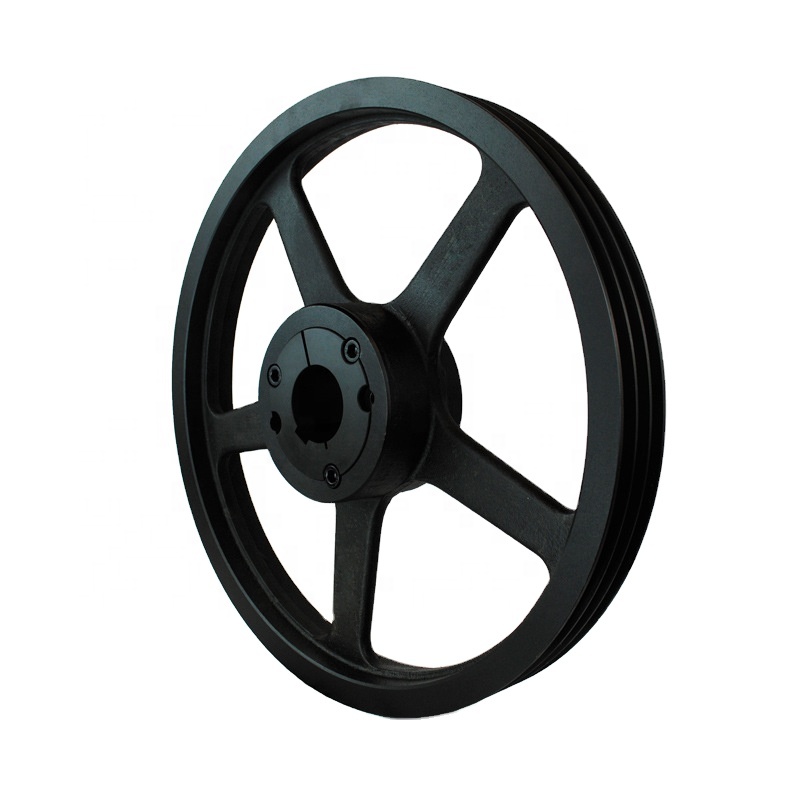
Here are the key material specifications for Milock wear-resistant components:
| Component Type | Base Material | Surface Treatment | Typical Hardness (HRC) | Ideal Application |
|---|---|---|---|---|
| Heavy-Duty Pulley | Ductile Iron (Grade 65-45-12) | Induction Hardening | 50-55 | Mining Conveyors, Crushers |
| Precision Bush | Alloy Steel (AISI 4140) | Carbonitriding | 58-62 | High-Speed Drives, Automotive Lines |
| General Duty Sheave | High-Strength Cast Steel | Precision Machining | 45-50 | Material Handling, Agricultural Equipment |
Challenge: Corrosion & Chemical Degradation in Hostile Environments & The Milock Defense
In food processing, chemical plants, or marine applications, moisture, salts, acids, and cleaning agents pose a silent threat. Standard steel components rust and pit, causing seizure and failure. This is where material science makes all the difference. For corrosion resistance, Milock utilizes stainless steel series (like 304 and 316) and offers specialized polymer composites and bronze alloys for specific chemical exposures. Raydafon Technology Group Co.,Limited doesn't just sell parts; it provides material solutions. Our engineers can recommend the optimal alloy based on your specific pH levels, temperature, and chemical contaminants, ensuring the component integrity of your Milock Pulleys & Bushes is never compromised by the environment.
The selection is backed by rigorous testing. See the comparative data below:
| Material Grade | Key Corrosion Resistance | Max Continuous Temp | Common Industry Use | Milock Product Code Example |
|---|---|---|---|---|
| AISI 316 Stainless Steel | Excellent vs. Chlorides, Acids | 800°F (427°C) | Marine, Pharma, Food & Beverage | MLK-BUSH-316 |
| Phosphor Bronze (SAE 65) | Excellent vs. Seawater, Wear | 500°F (260°C) | Pump Systems, Marine Bearings | MLK-PLY-PB |
| Engineered Polymer Composite | Resists Most Acids, Alkalis | 250°F (121°C) | Chemical Processing, Washdown Areas | MLK-BUSH-PC |
Frequently Asked Questions on Milock Materials
Q: What materials are Milock Pulleys & Bushes made from for high-temperature applications?
A: For applications involving sustained high heat, such as near ovens or dryers, Milock offers components made from heat-treated alloy steels (e.g., AISI 4340) and special high-temperature cast irons. These materials retain their strength and resist thermal fatigue, preventing deformation under thermal cycling. Raydafon can provide detailed temperature vs. load charts for specific material selections.
Q: Beyond metal, what materials are Milock Pulleys & Bushes made from for noise reduction and lightweight needs?
A: Absolutely. For applications where weight or noise is a primary concern, such as in automated assembly or textile machinery, Milock provides engineered polymer and composite bushes. These materials offer excellent wear resistance, inherent lubrication, and significant noise damping while being corrosion-proof. They are a perfect example of how Raydafon's material portfolio solves diverse operational challenges.
Partner with a Material Science Leader
Selecting the right component material is a strategic decision that impacts your bottom line. It's not just about buying a pulley or a bush; it's about investing in system reliability. Raydafon Technology Group Co.,Limited stands as your expert partner in this process. With decades of experience in metallurgy and polymer science, we don't just supply parts—we deliver engineered solutions that address the root cause of your equipment challenges. Our Milock line embodies this philosophy, offering a range of materials precisely tailored to conquer wear, corrosion, heat, and fatigue.
Ready to specify the perfect material for your application? Contact our technical sales team today for a consultation. Visit our website at https://www.raydafonmachinery.com to explore our full product catalog and technical resources.
For specific inquiries and quotes, please email us at: [email protected]
Supporting Research & Further Reading
Davis, J.R. (Ed.). (2001). *Surface Hardening of Steels: Understanding the Basics*. ASM International.
Budinski, K.G., & Budinski, M.K. (2010). *Engineering Materials: Properties and Selection* (9th ed.). Prentice Hall.
Callister, W.D., & Rethwisch, D.G. (2018). *Materials Science and Engineering: An Introduction* (10th ed.). Wiley.
Bhadeshia, H.K.D.H., & Honeycombe, R.W.K. (2017). *Steels: Microstructure and Properties* (4th ed.). Butterworth-Heinemann.
ASM Handbook Committee. (1990). *Properties and Selection: Irons, Steels, and High-Performance Alloys* (Vol. 1). ASM International.
Erich, F. (1987). *Handbook of Induction Heating*. Marcel Dekker.
Rabinowicz, E. (1995). *Friction and Wear of Materials* (2nd ed.). Wiley-Interscience.
Fontana, M.G. (2005). *Corrosion Engineering* (3rd ed.). McGraw-Hill.
Hutchings, I., & Shipway, P. (2017). *Tribology: Friction and Wear of Engineering Materials* (2nd ed.). Butterworth-Heinemann.
Broge, J.L. (2012). "Advanced Polymers in Mechanical Applications." *Machine Design Magazine*, 84(12), 46-50.
Related News
- What is a two-way 3-stage mini hydraulic cylinder?
- Why does my feed mixer gearbox overheat?
- Which industries use powder metallurgy components?
- What is the maximum temperature for a silicon carbide mechanical seal?
- How do you troubleshoot a reciprocating screw that is not retracting?
- How to calculate the force of a small hydraulic cylinder?
Leave me a message