- Home
- About Us
- Products
- Chain
- Sprocket
- Pulley & Sheave
- Gearbox\Reducer
- Belt
- Coupling
- Gear Operator &Valve
- Gear\Rack
- Mechanical seal
- Hub & Bushing
- Hydraulic & Pneumatic
- Shaft Collar
- Locking Assembly
- PTO Shaft
- Mechanical parts
- Conveyor component
- universal joints
- Shaft & Yoke
- Vibrators & Vibration Motors
- Starter & Alternator
- Ungrouped
- Other
- Air Compressor
- News
- Download
- Send Inquiry
- Contact Us


What is the maximum temperature for a silicon carbide mechanical seal?
What is the maximum temperature for a silicon carbide mechanical seal? If you are responsible for sourcing pump components, this is not just a technical curiosity—it is a daily purchasing decision that affects plant uptime and maintenance budgets. A silicon carbide mechanical seal is widely chosen for high-temperature chemical pumps, boiler feedwater systems, and hot oil circulation because it resists wear, corrosion, and thermal shock far better than carbon or tungsten carbide alternatives. However, the maximum allowable temperature depends on the entire seal assembly: the silicon carbide rotating and stationary faces, the secondary sealing elements, and the metal hardware. Ignoring these factors leads to premature leakage, cracked rings, and costly emergency shutdowns. At Raydafon Technology Group Co.,Limited, we help procurement teams select the correct silicon carbide seal configuration for their operating envelope, so every order matches real field conditions. This guide explains the true temperature limits, common high-heat failure scenarios, and how our engineering support removes guesswork from your buying process. Understanding this now can save thousands of dollars in avoided downtime and replacement purchases.
Understanding the Maximum Temperature for a Silicon Carbide Mechanical Seal
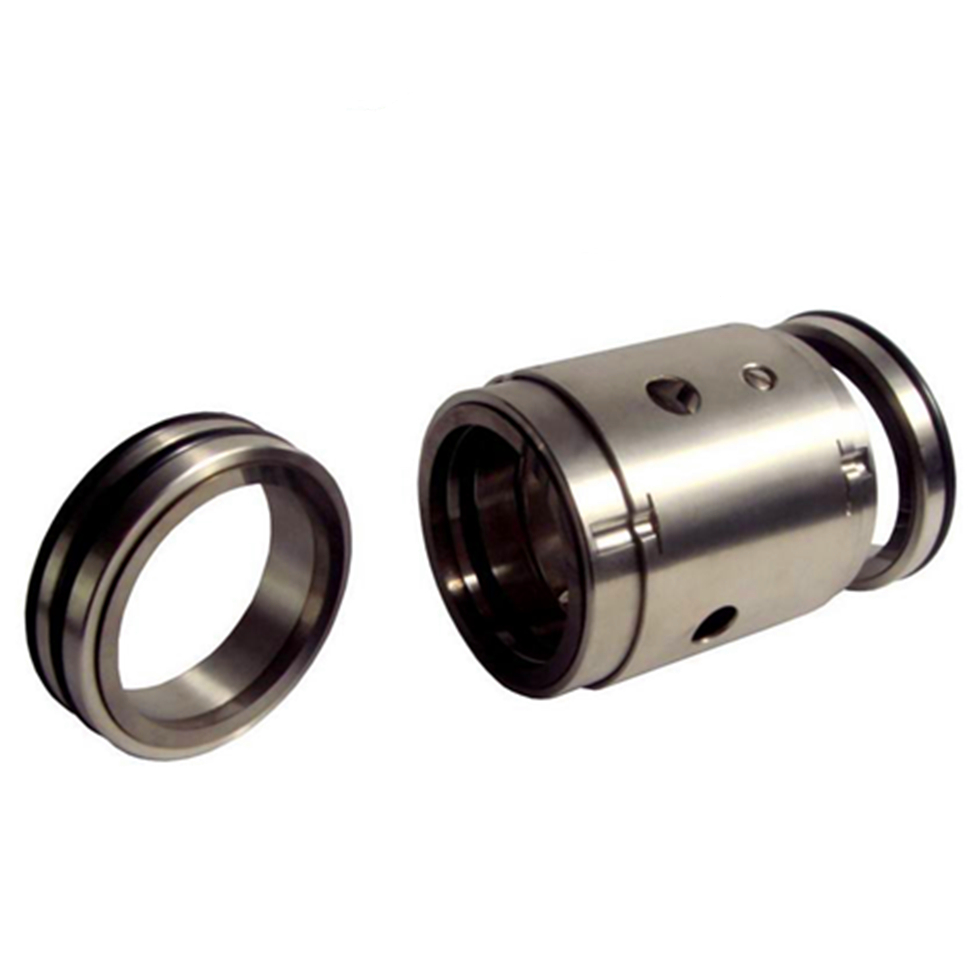
Silicon carbide as a material can withstand extremely high temperatures. Reaction-bonded and sintered silicon carbide grades typically retain their mechanical strength up to 1600°C in inert atmospheres and 1300–1400°C in oxidizing environments. This makes the seal faces themselves suitable for high-temperature slurry, molten salt, and hot gas applications. But a mechanical seal is a system, not just a pair of rings. O-rings made from FKM usually limit the assembly to about 200°C. FFKM or Kalrez can extend that to 300°C. Metal bellows seals without elastomers can operate above 400°C, provided the spring and housing materials are selected correctly. For procurement engineers, the key question is not only “What is the maximum temperature for a silicon carbide mechanical seal?” but “Which seal configuration meets my pump’s full temperature and pressure profile?” Raydafon Technology Group Co.,Limited provides both standard and custom configurations to close that gap.
Common Failure Scenarios at High Heat
Picture a chemical plant running a hot oil circulation pump at 280°C. The procurement team buys a standard silicon carbide mechanical seal with FKM O-rings because the datasheet says the silicon carbide faces handle high heat. Within two weeks, the pump leaks at the gland. The real culprit is not the silicon carbide rings—it is the O-rings that softened and lost elasticity. In another scenario, a boiler feedwater pump starts and stops frequently, producing thermal shock that cracks a low-grade sintered silicon carbide seal face. These failures create downtime, replacement costs, and difficult conversations with maintenance teams. The solution is to map the full temperature cycle, select compatible secondary seals, and choose a silicon carbide grade engineered for thermal shock resistance. Raydafon Technology Group Co.,Limited asks the right questions before quoting: fluid temperature, pressure spikes, start-stop frequency, and chemical exposure. This prevents the most common procurement mistakes that lead to short seal life.
How Raydafon Technology Group Solves Extreme Temperature Challenges
Instead of offering a generic silicon carbide mechanical seal, Raydafon Technology Group Co.,Limited starts with your operating conditions and builds a seal package around them. For applications up to 200°C, we pair high-purity sintered silicon carbide with FKM O-rings and stainless steel hardware. For 200–300°C, we upgrade to FFKM O-rings and high-temperature alloys. Above 300°C, we recommend metal bellows or spring-energized PTFE secondary seals to eliminate elastomer limitations. Our silicon carbide rings are available in pressureless sintered, reaction-bonded, and graphite-loaded grades to balance cost, wear life, and thermal shock resistance. We also provide hard-face coatings and diamond-lapped surfaces for reduced friction and better dry-running capability. This means buyers do not need to become seal engineers—they just need to share the application data and receive a validated recommendation. Each proposal includes material certificates, dimensional drawings, and a clear explanation of the maximum allowable temperature for the complete assembly.
Silicon Carbide Mechanical Seal Performance Parameters
The table below summarizes typical values for Raydafon silicon carbide mechanical seal components and the main factors that affect maximum service temperature. Use these parameters to compare suppliers accurately and avoid false assumptions.
| Parameter | Typical Value | High-Temperature Note |
|---|---|---|
| Max material temperature (inert atmosphere) | 1600°C | Seal faces remain stable; assembly limits apply |
| Max material temperature (oxidizing atmosphere) | 1300–1400°C | Long-term exposure may require surface protection |
| Max assembly temperature with FKM O-rings | 200°C | Most economical option for moderate heat |
| Max assembly temperature with FFKM O-rings | 300°C | Recommended for hot oil and chemical pumps |
| Max assembly temperature with metal bellows | 400°C+ | No elastomer, suitable for extreme heat |
| Hardness | 2500–2800 HV | Excellent wear resistance against abrasive media |
| Flexural strength | 400–500 MPa | High strength reduces cracking under thermal shock |
| Thermal conductivity | 120–150 W/m·K | Fast heat dissipation protects the seal faces |
| Chemical resistance | pH 0–14 | Suitable for aggressive acids, alkalis, and solvents |
For procurement purposes, always confirm whether the maximum temperature refers to the silicon carbide face material or the entire seal assembly. Raydafon Technology Group Co.,Limited provides both values on request, avoiding misleading comparisons between suppliers.
Frequently Asked Questions About Maximum Temperature
Q: What is the maximum temperature for a silicon carbide mechanical seal in a standard chemical pump?
A: In a standard pump using elastomer O-rings, the practical maximum is typically 200°C with FKM or 300°C with FFKM. The silicon carbide seal faces themselves can handle much higher temperatures, so the limiting factor is usually the secondary sealing element. Raydafon Technology Group Co.,Limited helps you identify the exact limiting component for your pump model and recommends the most cost-effective upgrade path.
Q: Can Raydafon Technology Group Co.,Limited supply a silicon carbide mechanical seal that works above 400°C?
A: Yes. By using metal bellows or spring-energized PTFE secondary seals and high-temperature alloys, we configure silicon carbide mechanical seal assemblies that operate above 400°C. These designs remove elastomer failure points and maintain face flatness at elevated temperatures. Contact us with your fluid, pressure, and shaft speed to receive a feasibility review and a detailed quotation.
Research Papers on Silicon Carbide Mechanical Seals
These peer-reviewed studies provide deeper technical background on silicon carbide materials, thermal behavior, and mechanical seal performance for buyers and engineers who want to validate design choices.
1. Zhang, Y., Wang, J., & Li, H. (2019). Tribological behavior of silicon carbide seals under high-temperature water. Wear, 426–427, 1230–1238.
2. Kim, S., Lee, J., & Park, C. (2018). Thermal shock resistance of reaction-bonded silicon carbide ceramics. Journal of the European Ceramic Society, 38(4), 1520–1527.
3. Chen, L., Xu, M., & Zhao, T. (2020). Effect of graphite addition on friction and wear of SiC mechanical seal faces. Tribology International, 144, 106123.
4. Wang, H., Liu, B., & Sun, Y. (2017). High-temperature strength degradation of sintered silicon carbide in oxidizing environments. Ceramics International, 43(1), 1025–1032.
5. Li, J., Zhang, Q., & Chen, G. (2021). Thermal stress analysis of silicon carbide seal rings under transient heat loads. Engineering Failure Analysis, 120, 105087.
6. Rodriguez, A., & Schmidt, F. (2016). Performance of elastomer-free mechanical seals at elevated temperatures. Sealing Technology, 2016(8), 7–12.
7. Park, S., Kim, H., & Cho, D. (2019). Corrosion resistance of pressureless sintered SiC in acidic and alkaline solutions. Journal of Materials Science, 54(15), 10644–10656.
8. Huang, Z., Wu, X., & Liang, Y. (2022). Microstructure and mechanical properties of SiC-graphite composites for high-temperature seals. Materials Chemistry and Physics, 280, 125789.
9. Smith, R. A., & Turner, P. (2015). Maximum operating temperature of silicon carbide mechanical seals in hot gas applications. Proceedings of the Institution of Mechanical Engineers, Part J: Journal of Engineering Tribology, 229(10), 1193–1201.
10. Zhou, X., Wang, M., & Feng, D. (2020). Thermal conductivity enhancement in silicon carbide ceramics for pump seal applications. International Journal of Applied Ceramic Technology, 17(3), 985–994.
Contact Raydafon Technology Group Co.,Limited
Ready to stop guessing about seal temperature limits? Share your pump type, fluid, and operating temperature with our engineering team. We will recommend a silicon carbide mechanical seal configuration that matches your thermal and chemical conditions without overpaying for unnecessary upgrades. If you have already faced high-temperature seal failure, tell us the failure photos and process data—we can usually identify the root cause within one working day.
Raydafon Technology Group Co.,Limited is a trusted supplier of high-performance mechanical seals and silicon carbide components for global pump manufacturers and end users. We combine in-house material processing, precision lapping, and application engineering to deliver reliable sealing solutions for demanding industrial processes. Visit https://www.raydafonmachinery.com or email [email protected] to request a quote or technical consultation.
Related News
- What is a two-way 3-stage mini hydraulic cylinder?
- Why does my feed mixer gearbox overheat?
- Which industries use powder metallurgy components?
- How do you troubleshoot a reciprocating screw that is not retracting?
- How to calculate the force of a small hydraulic cylinder?
- Can a Raydafon rubber device chain tensioner be repaired or only replaced?
Leave me a message