- Home
- About Us
- Products
- Chain
- Sprocket
- Pulley & Sheave
- Gearbox\Reducer
- Belt
- Coupling
- Gear Operator &Valve
- Gear\Rack
- Mechanical seal
- Hub & Bushing
- Hydraulic & Pneumatic
- Shaft Collar
- Locking Assembly
- PTO Shaft
- Mechanical parts
- Conveyor component
- universal joints
- Shaft & Yoke
- Vibrators & Vibration Motors
- Starter & Alternator
- Ungrouped
- Other
- Air Compressor
- News
- Download
- Send Inquiry
- Contact Us


Which industries use powder metallurgy components?
Which industries use powder metallurgy components? If you are sourcing metal parts for automotive transmissions, electric power tools, medical devices, or smart locking systems, this question likely sits at the center of your supplier evaluation. Powder metallurgy (PM) transforms metal powders into dense, near-net-shape components through controlled compaction and sintering. Compared with casting or machining, PM reduces material waste, shortens production cycles, and improves batch-to-batch consistency. From automotive gears, synchronizer hubs, and oil pump rotors to surgical instrument parts, brushless motor brackets, and lock cylinders, PM is used where complex geometry, medium-to-high volume, and repeatable tolerances are non-negotiable. Yet many procurement teams still struggle with uneven density, hidden porosity, or dimensional drift when suppliers do not control powder blends, compaction pressure, or sintering atmospheres. Raydafon Technology Group Co.,Limited helps global buyers avoid these pitfalls by integrating material selection, tooling design, sintering optimization, and secondary finishing under one quality system. In this article, we break down which industries rely on PM components, what pain points buyers encounter, which technical parameters matter most, and how to verify a supplier before placing your next order. You will also find two quick Q&As and a practical comparison table to support your sourcing decision.
Why Powder Metallurgy Is Reshaping Industrial Sourcing
Imagine receiving a shipment of 20,000 pinion gears for an electric drill assembly line, only to discover that 6 percent fall outside the specified density range. The result: your quality team halts production, your inventory gets quarantined, and your production manager asks why the supplier’s sintering profile was not validated before shipping. This is one of the most common pain points in powder metallurgy sourcing: inconsistent density caused by poor powder blending or uncontrolled furnace conditions.
Raydafon Technology Group Co.,Limited addresses this by establishing a process window for each material grade that controls compaction pressure, sintering temperature, and atmosphere composition. We also perform inline density checks and dimensional inspections before release, so you receive components that meet your print instead of a costly sorting exercise.
| Process | Typical Density (% of theoretical) | Dimensional Tolerance | Best for |
|---|---|---|---|
| Conventional machining | 100% (wrought material) | ±0.01 mm or better | Low volume, simple geometry |
| Conventional sintering | 88–92% | ±0.05 mm | Medium-to-high volume, complex shapes |
| High-density PM (warm compaction) | 93–96% | ±0.03 mm | High-strength gears and structural parts |
| Metal injection molding (MIM) | 96–99% | ±0.3% of dimension | Small, intricate medical or electronic parts |
Which Industries Use Powder Metallurgy Components?
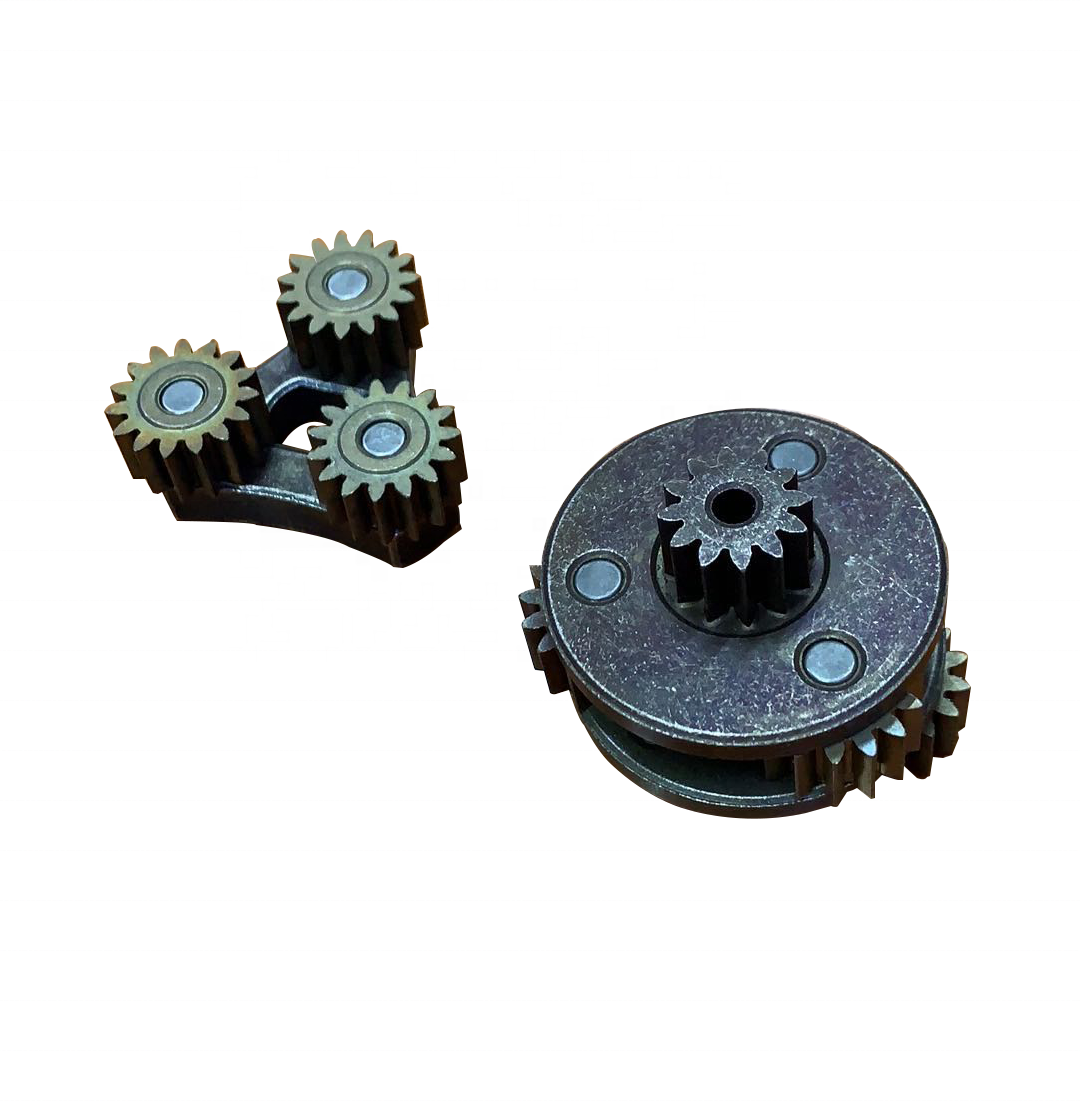
The short answer: automotive, power tools, medical devices, aerospace, locking systems, home appliances, hydraulics, and office equipment. But procurement teams need specifics. Automotive buyers source sintered steel synchronizer hubs, valve seat inserts, and oil pump gears. Power tool manufacturers require high-density bevel gears and planetary carriers. Medical device suppliers use sintered stainless steel or titanium for forceps, scissors, and implant components. Lock manufacturers rely on PM for cylinders, shackles, and key blanks. Each industry has different requirements for density, corrosion resistance, and magnetic performance.
| Industry | Typical PM Components | Key Requirements |
|---|---|---|
| Automotive | Gears, synchronizer hubs, valve seats, oil pump rotors | High fatigue strength, wear resistance |
| Power tools | Bevel gears, planetary carriers, motor brackets | High density, impact toughness |
| Medical devices | Forceps, scissors, implant anchors | Biocompatibility, fine surface finish |
| Locking systems | Cylinders, shackles, key blanks | Dimensional accuracy, corrosion resistance |
| Home appliances | Refrigerator compressor parts, washing machine gears | Low noise, long service life |
| Aerospace | Lightweight brackets, sensor housings | High strength-to-weight ratio, traceability |
Pain Point: Inconsistent Supplier Quality and How Raydafon Solves It
A purchasing manager at a mid-sized lock manufacturer ordered 50,000 sintered lock cylinders from a lower-cost supplier. Within three months, field returns increased because some cylinders had microcracks caused by uncontrolled cooling rates. The buyer had to audit the supplier, pay for rework, and explain the failure to upper management. This scenario repeats itself when suppliers cut corners on sintering atmosphere control or skip pre-production process validation.
Raydafon Technology Group Co.,Limited prevents these failures through pre-production process validation, including sintering curve analysis, carbon potential control, and dimensional capability studies. We encourage buyers to request PPAP-style documentation and maintain a material traceability record for every batch. Below is a quick reference for common PM defects and the controls we apply.
| Defect | Typical Cause | Raydafon Control |
|---|---|---|
| Low density | Insufficient compaction pressure | Closed-loop press control with pressure monitoring |
| Microcracks | Rapid cooling or uneven density | Controlled cooling rate and pre-sintering wax removal |
| Dimensional drift | Tool wear or powder lot variation | Statistical process control and tool life tracking |
| High porosity | Poor powder blend or low sintering temperature | Green density measurement and furnace profile audits |
| Surface oxidation | Inadequate atmosphere | Continuous atmosphere monitoring with oxygen probes |
Technical Parameters Buyers Must Check
Before you approve a powder metallurgy drawing, ask your supplier for a material data sheet that goes beyond hardness. Density, tensile strength, yield strength, and dimensional tolerance are what determine whether a sintered gear will survive in an automotive transmission or a cordless drill. Use the table below as a pre-sourcing checklist for common PM materials.
| Parameter | Typical Range for Sintered Steel | Why It Matters |
|---|---|---|
| Sintered density | 6.6–7.4 g/cm³ | Higher density improves fatigue strength and sealing |
| Hardness | HRB 60–HRC 40 (depending on heat treatment) | Controls wear life in gears and cams |
| Tensile strength | 400–900 MPa | Determines load capacity of structural parts |
| Dimensional tolerance | ±0.03 to ±0.08 mm | Affects assembly fit and noise |
| Sintering temperature | 1120–1250 °C for ferrous grades | Directly influences particle bonding and pore shape |
| Carbon content | 0.2–0.8% (prealloyed or admixed) | Adjusts strength, hardenability, and machinability |
At Raydafon Technology Group Co.,Limited, we provide this data up front and share it with your engineering team before tooling begins. That helps avoid expensive design changes later.
FAQ: Which Industries Use Powder Metallurgy Components?
Q: Which industries use powder metallurgy components for high-volume metal parts?
A: Automotive, power tools, home appliances, and office equipment are the largest users because PM offers low per-piece cost and good repeatability for gears, bearings, brackets, and structural parts. Medical and aerospace applications use PM when small, complex, or high-strength parts are needed with tight traceability.
Q: Why should a procurement team ask “Which industries use powder metallurgy components?” before changing suppliers?
A: It reveals whether the supplier has proven experience with similar material systems and tolerance requirements. For example, a supplier serving medical or automotive clients usually has stricter process controls, cleaner sintering atmospheres, and better documentation than one focused only on low-cost consumer parts. At Raydafon, we maintain separate process routes for different industry requirements and can share relevant case studies.
How Raydafon Technology Group Co.,Limited Supports Global Buyers
Many buyers do not need a huge supplier; they need a partner who can shorten the learning curve. Raydafon Technology Group Co.,Limited offers custom powder metallurgy development, in-house tooling, sintering, sizing, and secondary CNC machining. We also provide material selection support, density optimization, and fatigue testing for critical parts. Our goal is to help you reduce total cost per component without sacrificing mechanical properties.
- Free material recommendation based on your load, wear, and corrosion requirements
- Prototype tooling and pre-production samples within agreed lead times
- Batch-level inspection reports with density, hardness, and dimensional data
- Export packaging and shipping documentation tailored to your destination
This structure keeps procurement teams in control while reducing the number of supplier audits and corrective actions.
Conclusion: Turn PM Sourcing into a Competitive Advantage
Once you know which industries use powder metallurgy components, you can align your supplier’s process capability with your product’s mechanical demands. Instead of accepting high scrap rates or inconsistent deliveries, start with a technical review of density, tolerance, and material grade. Then ask for process validation data before pilot production.
If you are evaluating a new PM supplier, send your drawing or 3D model for a free manufacturability review. Our engineers will check whether powder metallurgy is the right process for your geometry and volume, and what secondary operations may be required. This avoids overpaying for machining or under-specifying a part that will fail in the field.
For more than a decade, Raydafon Technology Group Co.,Limited has supplied custom powder metallurgy components to automotive, power tool, medical, and locking system manufacturers worldwide. From material selection and tooling design to sintering and secondary machining, our engineers help you reduce total cost and improve part consistency. Send your drawings or specifications to [email protected] for a free technical review and quotation.
German, R. M. (2005). Powder injection molding of metals and ceramics. International Journal of Powder Metallurgy, 41(3), 45–52.
Klar, E., & Shafer, W. M. (1998). High-density processing of ferrous powders. Metal Powder Report, 53(6), 28–34.
Lawcock, R., & Davies, T. J. (1990). Effect of carbon content on fatigue behavior of sintered steels. Powder Metallurgy, 33(2), 147–155.
Danninger, H., Gierl, C., & Brandstätter, W. (2003). Sintering of Cr-Mo prealloyed steels. Powder Metallurgy Progress, 3(2), 75–85.
Upadhyaya, G. S. (2002). Sintered metallic and ceramic materials: preparation, properties and applications. Journal of Materials Processing Technology, 121(2–3), 215–221.
Simchi, A., & Petzoldt, F. (2009). Cosintering of powder injection molded parts: a review. International Journal of Powder Metallurgy, 45(2), 25–35.
Beiss, P., & Dalgic, M. (2001). Effect of pore morphology on fatigue strength of sintered steels. Powder Metallurgy, 44(2), 142–151.
Bocchini, G. F. (1999). Warm compaction of metal powders: why it works, why it requires a sophisticated engineering approach. Powder Metallurgy, 42(2), 125–132.
Rutz, H. G., & Hanejko, F. G. (1995). High density processing of ferrous alloys via warm compaction. Advances in Powder Metallurgy and Particulate Materials, 1, 117–124.
Schlieper, G., & Thümmler, F. (1979). Sintering behaviour of iron-copper and iron-copper-carbon alloys. Powder Metallurgy International, 11(4), 172–176.
Previous :
-
Related News
- What is the maximum temperature for a silicon carbide mechanical seal?
- How do you troubleshoot a reciprocating screw that is not retracting?
- How to calculate the force of a small hydraulic cylinder?
- Can a Raydafon rubber device chain tensioner be repaired or only replaced?
- How do vibration motors work in industrial applications?
- Where to buy replacement shaft and yoke parts?
Leave me a message