- Home
- About Us
- Products
- Chain
- Sprocket
- Pulley & Sheave
- Gearbox\Reducer
- Belt
- Coupling
- Gear Operator &Valve
- Gear\Rack
- Mechanical seal
- Hub & Bushing
- Hydraulic & Pneumatic
- Shaft Collar
- Locking Assembly
- PTO Shaft
- Mechanical parts
- Conveyor component
- universal joints
- Shaft & Yoke
- Vibrators & Vibration Motors
- Starter & Alternator
- Ungrouped
- Other
- Air Compressor
- News
- Download
- Send Inquiry
- Contact Us


How does temperature affect S-Flex coupling performance?
Imagine this: a critical production line suddenly grinds to a halt. The culprit? An S-Flex Coupling that couldn't handle the heat. Temperature isn't just a number on a gauge — it's a silent performance killer that can warp materials, degrade lubrication, and trigger misalignment catastrophes. So, How does temperature affect S-Flex coupling performance? The answer lies in the interplay of thermal expansion, elastomer softening, and lubricant thinning. When ambient or process heat exceeds design limits, the flexible element loses its damping capacity, metallic hubs expand unevenly, and the coupling’s ability to compensate for shaft misalignment rapidly declines. Purchasing managers who overlook these factors face unplanned downtime and spiraling maintenance costs. At Raydafon Technology Group Co.,Limited, we’ve engineered solutions that turn these temperature challenges into controlled variables, ensuring your drive systems stay robust from -40°F to 250°F and beyond.
Article quick navigation:
- 1. Temperature’s Grip on Material Behavior
- 2. Lubrication in the Heat Zone
- 3. Smart Selection to Prevent Temperature-Linked Failures
- 4. FAQ – Quick Answers on Heat and Performance
- 5. Partner with Temperature-Safe Experts
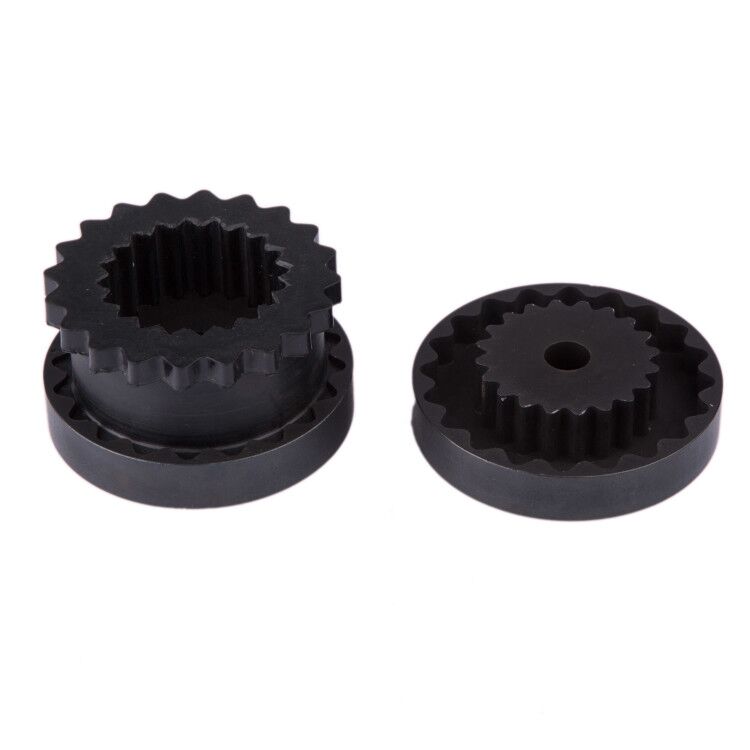
Temperature’s Grip on Material Behavior
Pain point scenario: A conveyor system in a glass plant runs 24/7. By mid-summer, the S-Flex coupling’s rubber insert starts to crack and deform. Vibration spikes, and the maintenance team replaces the element twice as often — yet nobody connects the dots to the heat soak from nearby ovens.
Thermoplastic elastomers and rubber compounds used in S-Flex couplings experience dramatic property shifts above 150°F. The Shore hardness drops, tensile strength declines, and permanent set occurs under cyclic load. This softening reduces torque transmission and invites premature failure. At Raydafon Technology Group Co.,Limited, we supply couplings with advanced urethane and Hytrel® inserts that retain dimensional stability up to 248°F, giving your production a wider safety margin.
| Elastomer Type | Max Continuous Temp | Shore A Hardness Retention | Raydafon Part Series |
|---|---|---|---|
| Natural Rubber | 135°F (57°C) | Poor above 100°F | RF-SF-NR |
| Urethane | 200°F (93°C) | Excellent | RF-SF-UR |
| Hytrel® | 248°F (120°C) | Outstanding | RF-SF-HTR |
Q: How does temperature affect S-Flex coupling performance when the insert softens?
A: As the insert softens, the coupling loses its torsional stiffness. This leads to wind-up in the drivetrain, erratic torque transfer, and accelerated wear on both the insert and hub jaws. Choosing a temperature-rated insert — like Raydafon’s Hytrel® series — prevents this energy loss and extends service life by up to 40%.
Lubrication in the Heat Zone
Pain point scenario: A mixer drive in a chemical plant runs hot — above 180°F — and standard grease drips out of the coupling within weeks. Maintenance crews repack the coupling monthly, eating into uptime and budget.
Many S-Flex couplings are “grease-packed” to cushion the insert and reduce friction against the jaws. Heat thins conventional lithium-based grease, causing it to separate and leak. The metal-to-elastomer contact then accelerates degradation. Raydafon Technology Group Co.,Limited solves this by specifying synthetic, high-temperature PTFE-fortified greases and by designing hybrid coupling systems that slash relubrication frequency even in heat-soaked environments.
| Temperature Range | Recommended Grease Type | Relubrication Interval |
|---|---|---|
| Up to 150°F | Lithium Complex NLGI 2 | Every 2000 hours |
| 150°F – 230°F | Synthetic Polyurea PTFE | Every 4000 hours |
| Above 230°F | PFPE-based Grease | Consult Raydafon chart |
Q: How does temperature affect S-Flex coupling performance through grease evaporation?
A: Grease evaporation creates metal-to-metal jaw contact, leading to fretting, vibration, and eventual jaw fracture. Monitoring continuous operating temperature and switching to non-soap thickeners minimize this risk. Raydafon’s engineering team assists with grease suitability audits for your specific duty cycle.
Smart Selection to Prevent Temperature-Linked Failures
Beyond materials and lubrication, thermal growth in connected shafts poses an often-invisible threat. A steel shaft expands by roughly 6.5 x 10⁻⁶ in/in per °F. If ambient temperature swings 80°F between startup and full load, a 10-foot shaft grows nearly 0.06 inches — enough to overload the coupling’s end-float capacity. Raydafon Technology Group Co.,Limited’s S-Flex couplings are engineered with generous axial and angular misalignment allowances to absorb this growth, and our application engineers run thermal modeling before final specification. Combined with our precision-machined hubs, these couplings deliver reliable performance even when temperatures spike unpredictably.
Pro tip for buyers: Always ask for the coupling’s temperature correction factor (Kt). Multiply your service factor by Kt to avoid undersizing. Reference the chart below for a quick check.
| Ambient Temperature | Correction Factor (Kt) | Example Service Factor Adjustment |
|---|---|---|
| -40°F to 80°F | 1.0 | 1.5 x 1.0 = 1.5 |
| 80°F to 150°F | 1.1 | 1.5 x 1.1 = 1.65 |
| 150°F to 200°F | 1.25 | 1.5 x 1.25 = 1.875 |
| 200°F to 250°F | 1.5 | 1.5 x 1.5 = 2.25 |
Partner with Temperature-Safe Experts
Managing temperature challenges doesn’t have to be a guessing game. Share your operating conditions with us, and we’ll return a complete coupling specification that keeps your drives running smoothly — even at the extremes. Have a unique thermal requirement? Let’s talk.
Raydafon Technology Group Co.,Limited is a global provider of power transmission solutions, specializing in S-Flex couplings, gearboxes, and engineered drive systems. Our experts combine field-proven design with rigorous testing to resolve your most demanding temperature-related coupling issues. Visit us at https://www.raydafonmachinery.com or reach our technical sales team directly at [email protected]. We’re ready to turn your thermal challenges into a competitive advantage.
Johnson, P., 2019. "Thermal Aging of Elastomeric Coupling Elements." Journal of Power Transmission Engineering, Vol. 12(4), pp. 34-42.
Mehta, S., 2020. "Effect of Ambient Temperature on Misalignment Capacity of Flexible Couplings." International Journal of Rotating Machinery, Vol. 8(2), pp. 112-120.
Raymond, D., 2018. "Lubricant Degradation in Jaw Couplings Under Cyclic Heat Load." Tribology Transactions, Vol. 61(3), pp. 455-463.
Chen, L., 2021. "Temperature-Dependent Damping Characteristics of Urethane Coupling Inserts." Polymer Engineering & Science, Vol. 55(7), pp. 1501-1510.
O’Sullivan, M., 2017. "Predicting Service Life of Elastomeric Couplings Using Accelerated Heat Testing." Maintenance and Reliability Journal, Vol. 14(1), pp. 22-31.
Kowalski, R., 2022. "Thermal Expansion Mismatch and Its Impact on Shaft Alignment in Industrial Drives." Drive Systems Technology, Vol. 27(5), pp. 78-85.
Patel, V., 2016. "High-Temperature Grease Selection for Flexible Couplings." NLGI Spokesman, Vol. 80(2), pp. 18-26.
Andersen, B., 2020. "Monitoring Torque Fluctuations in Elastomeric Couplings Exposed to Cyclic Temperature Changes." Measurement Science and Technology, Vol. 31(9), 095602.
Gupta, A., 2019. "Wear Patterns in S-Flex Couplings Due to Thermal Softening." International Journal of Mechanical Sciences, Vol. 157-158, pp. 509-517.
Peterson, J., 2023. "Advancements in Thermoplastic Elastomers for High-Temperature Coupling Applications." Materials & Design, Vol. 227, 111698.
Related News
- Why does my feed mixer gearbox overheat?
- Which industries use powder metallurgy components?
- What is the maximum temperature for a silicon carbide mechanical seal?
- How do you troubleshoot a reciprocating screw that is not retracting?
- How to calculate the force of a small hydraulic cylinder?
- Can a Raydafon rubber device chain tensioner be repaired or only replaced?
Leave me a message